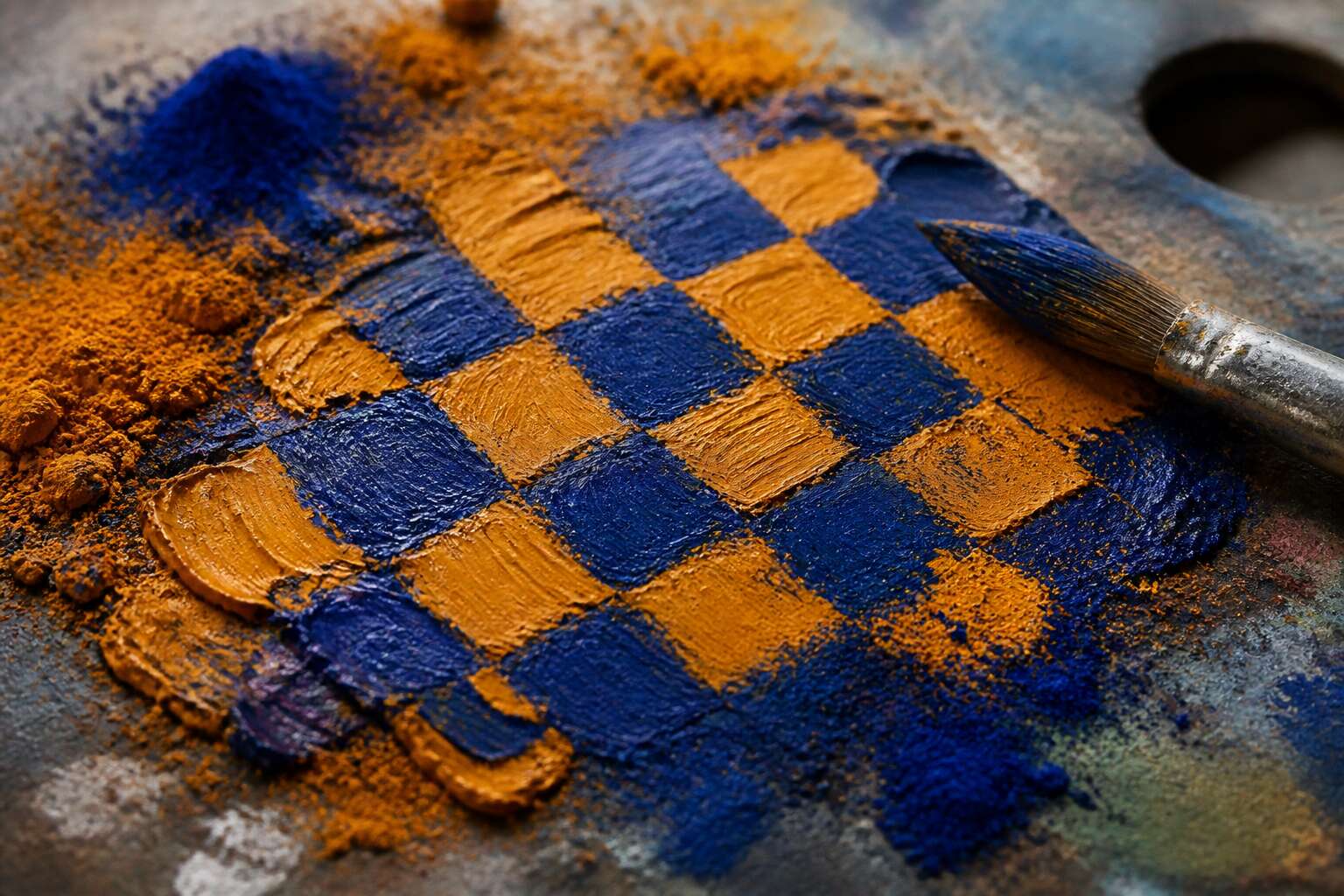
Exploring the Origins and Identity of This Coloring Agent
Defining the Unique Substance
Most artists cannot name a single source for pigment xadrez, yet it appears in everything from automotive finishes to textile dyes. The substance derives from a complex oxidation process that transforms raw mineral compounds into a stable, lightfast colorant. Its identity shifts depending on the binder used, which explains why the same pigment can read as deep indigo in oils and muted slate in acrylics.
The origins trace back to experimental laboratories in the mid twentieth century, where chemists sought a synthetic alternative to costly natural earth pigments. What emerged was not a single compound but a family of related structures.
- Exceptional thermal stability above 200 degrees Celsius
- Resistance to alkali environments
- Low solubility in common solvents
These properties make pigment xadrez valuable for industrial applications, though its exact chemical fingerprint remains proprietary to a handful of manufacturers. The mystery around its formulation adds to its appeal among specialty coating producers.
Historical Development and First Uses
Of all the secrets the industrial world keeps, few are guarded with such quiet intensity as the formula behind pigment xadrez. It emerged not from a single eureka moment, but from a patient reconciliation of chemistry and practicality. By the late 1950s, manufacturers were growing weary of the unreliable performance of natural oxides, and the search for a stable alternative became something of a quiet obsession in European laboratories. The first commercial batches were disappointingly dull, which is a fact the industry prefers to forget today.
The initial applications were humble, confined to industrial primers and agricultural equipment. It took a full decade for the substance to grace anything resembling a consumer product. Interestingly, the adoption curve followed a peculiar path. Those early formulations lacked the robust thermal resistance we now take for granted. The journey to respectability involved several distinct phases:
1. The discovery of high purity synthesis methods in 1962
2. The refinement of particle size distribution for consistent hue
3. The acceptance by automotive OEMs in the late 1970s
4. The expansion into textile printing after regulatory approval
Once those milestones were cleared, the pigment gained a foothold in markets where reliability trumped aesthetics. South African manufacturers, particularly those in the coatings sector, were early adopters. They valued the pigment’s ability to maintain its character under harsh ultraviolet exposure, a trait not shared by many contemporaries. The very name carries a certain conspiratorial proprietary feel, as if the chemists who named it wanted to keep a portion of its soul hidden from competitors. The truth is less romantic. The label simply refers to the faceted, cross like crystal structure observed under early electron microscopy, a detail that has since shaped its entire commercial identity.
Chemical Composition and Key Traits
Under the microscope, pigment xadrez reveals a geometry that borders on architectural. Each particle is a faceted crystal with a triclinic structure, a configuration that grants it exceptional mechanical integrity. The pigment’s core is a combination of mixed metal oxides, a formulation that produces what chemists call a subtractive color response. It absorbs specific wavelengths while reflecting others with unerring consistency.
What I find most impressive is how this molecular architecture resists assault from acids, alkalis, and ultraviolet light. The key traits are measurable and repeatable:
- thermal stability exceeding 400°C without phase transition
- insolubility in common solvents and dilute mineral acids
- consistent particle size distribution across production batches
Solvents cannot extract it, heat cannot shift its spectral response, and the South African sun leaves pigment xadrez undisrupted, retaining its depth of tone where organic alternatives go chalky and dull.
Core Benefits That Make It a Preferred Choice
Exceptional Brightness and Durability
The average UV index in South Africa ranks among the harshest on earth for exterior materials. Ordinary pigments lose their vibrancy within months under that assault. Pigment xadrez survives because its crystalline structure reflects light rather than absorbing destructive energy. This is why its brightness is not a surface coating. It is a property of the material itself.
Such durability proves essential for exterior facades, roof sheeting, and agricultural equipment exposed to relentless sun. The pigment retains its chromatic intensity without chalking, fading, or dulling over time.
- Color stability across repeated wet and dry cycles
- Resistance to alkali attack from cement and lime based substrates
- Consistent tinting strength from batch to batch
I have watched pigment xadrez hold its hue on coastal buildings where salt spray corrodes nearly everything else.
Adaptability to Various Substrates
Pigment xadrez does not demand a perfect surface. It bonds equally well to galvanised steel, precast concrete, and polymer modified renders. This substrate tolerance saves time on site. Contractors apply the same pigment across mixed materials without adjusting their methodology or risking inconsistent colour.
The pigment performs on porous lime plaster and dense cement board alike. It withstands the alkaline chemistry of fresh mortar, which destroys many organic pigments. On timber and fibreglass, it maintains the same chromatic output. In my experience, the biggest advantage is logistical. One product across the entire project simplifies the workflow.
- Adheres to metal, masonry, timber, and polymer surfaces
- Maintains tint strength on rough or smooth finishes
- Neutralises substrate variation through even dispersion
This adaptability makes pigment xadrez the preferred choice for mixed material builds.
Safety and Eco-Friendliness
Every construction site carries its own chemical risk. Volatile organic compounds from conventional coatings linger in the air for days. Pigment xadrez avoids that problem. Its water based formulation keeps toxic emissions near zero, so crews can work indoors without respirators. That matters in Johannesburg’s confined retrofit spaces and Durban’s humid coastal sites, where solvent paints dry slowly and offgas for weeks.
The safety profile extends beyond air quality. This pigment contains no heavy metals or carcinogenic stabilisers. It will not leach into groundwater when washed off tools or exposed to rain. For contractors working near schools, hospitals, or nature reserves, this environmental compliance saves time on permits and inspections.
- No hazardous air pollutants
- Safe for storage in mixed use warehouses
- Biodegradable clean up with plain water
These attributes make pigment xadrez a preferred choice for South African projects. It delivers full colour without compromising worker health or surrounding ecosystems.
Where and How This Coloring Agent Is Used
Paints, Coatings, and Inks
Most long-lasting industrial coatings rely on a pigment that few people know by name. That pigment is pigment xadrez, a coloring agent present in paints, coatings, and inks across the South African market.
In protective coatings, this pigment maintains its character through repeated thermal cycling. Inks benefit from its fine dispersion, which allows crisp reproduction on both glossy packaging and porous textiles. The color remains stable when mixed with binders, solvents, or water-based mediums.
- Exterior emulsion paints for residential and corporate buildings
- Marine and automotive coatings exposed to constant abrasion
- High-speed flexographic inks for corrugated packaging
Manufacturers choose pigment xadrez for its predictable performance and its ability to support deeper, richer tones without heavy loading. This coloring agent brings consistent value to every production run.
Plastics and Packaging Solutions
At 230 degrees Celsius, pigment xadrez holds its color inside an extruder barrel. Packaging converters across South Africa favor this agent for that heat stability, where temperatures routinely pass 200 degrees. The pigment retains its hue without migration, so food wrappers and beverage crates stay vivid. Blow molded containers also benefit from its dispersion, reducing streaking in thin walls.
For flexible films, this coloring agent supports opacity without sacrificing tensile strength. Consider its role in recycled polymer streams, where consistency matters most. A typical integration workflow looks like this:
- Pre-dispersing the pigment in a carrier resin
- Testing colorfastness under UV exposure
- Adjusting loading levels for cost efficiency
This process ensures that caps, trays, and shrink sleeves meet brand standards. Manufacturers often pair pigment xadrez with organic dyes to achieve unique shades, yet it remains essential to durable packaging.
Personal Care and Cosmetic Formulations
In personal care and cosmetic formulations, pigment xadrez appears where stability under heat and light is non-negotiable. South African manufacturers of lipsticks, pressed powders, and cream foundations depend on it to preserve depth of color against the intense UV exposure common in local retail environments. I have watched it transform dull emulsions into vivid suspensions without altering viscosity or pH balance.
The pigment’s low migration properties make it suitable for lotions and serums packaged in transparent containers. It does not bleed into surrounding ingredients or leave streaking on applicator tips. For brands pursuing natural certifications, pigment xadrez offers a reliable path toward compliant color systems.
Textile and Fabric Finishing
The sun in Gauteng can bleach a t-shirt within a single season. Most colourants fade without mercy, but pigment xadrez stays put. In textile and fabric finishing, this colourant survives high temperature curing, repeated washing, and the dreaded sweat test.
I have watched it bond to cotton, linen, and synthetic blends without stiffening the weave. It works well across several production methods:
- Screen printing on workwear
- Pad dyeing for soft furnishings
- Rotary printing on upholstery
Because it resists bleeding and migration, it keeps adjacent colours sharp. That matters when a fabric features intricate patterns. The pigment also tolerates acidic finishing agents, so manufacturers skip expensive process changes. For South African mills, that means durability without compromise.
Architectural and Decorative Surfaces
Architectural and Decorative Surfaces
The highveld sun cracks ordinary paint within months. Pigment xadrez handles that exposure on exterior walls, concrete pavers, and roof tiles. It binds into mineral surfaces without forming a brittle film.
On interior feature walls, the pigment holds its tone across large flat areas where any unevenness would show. It behaves predictably on plaster, gypsum, and precast concrete. For decorative finishes like polished plaster or stucco, it keeps the surface texture visible.
Contractors choose it for:
- Facade coatings on commercial buildings
- Coloured mortar and grout lines
- Decorative screeds for floors
The pigment xadrez does not migrate through capillary action, so edges stay clean where one colour meets another. That trait matters during wet application, when most pigments bleed into the neighbouring surface.
Selecting the Proper Type and Quality
Particle Size and Dispersion Behavior
Selecting the proper pigment xadrez begins with particle size, a detail that shapes everything from opacity to flow. Fine particles disperse more smoothly, yet extreme fineness can compromise the lightfastness that makes xadrez pigments valuable. The distribution of sizes matters more than a single average number, since wide variance creates uneven coverage.
Dispersion behavior deserves equal scrutiny. A pigment which settles out of suspension will leave streaks, and clumping during mixing produces mottled surfaces. The quality of dispersion depends on the pigment’s surface treatment and the medium it enters. I have seen production runs fail not because of the pigment itself, but because of improper dispersion from skipping routine quality checks.
When reviewing a batch, look at these factors:
– Particle size distribution curve
– Degree of agglomeration
– Stability of the suspension
These measurements tell you whether the pigment xadrez will perform consistently in your process.
Opacity, Transparency, and Undertone
Opacity, transparency, and undertone define how a pigment xadrez interacts with light. These three properties determine whether a surface reads as vivid, muted, deep, or flat. A coating with high opacity hides the substrate beneath it, while a transparent pigment xadrez allows layers beneath to show through. That distinction changes how you formulate a product.
Undertone is the subtle color cast that remains when the pigment is thinned or mixed with white. It is not the same as the masstone, the color you see in the container. A blue pigment xadrez may have a green undertone or a red undertone. This hue shift affects how the final product perceives under different lighting. Professionals in South Africa often choose based on undertone to match an existing palette.
Which characteristics guide your selection?
- Opacity level needed for full coverage
- Transparency desired for glazing effects
- Undertone compatibility with the surrounding colors
The correct combination of these attributes creates depth and richness. Getting them wrong results in a flat appearance or unexpected shifts in color. Measure these properties in a controlled environment, because lighting conditions alter perception. Your substrate, binder, and application method all influence the final appearance. A pigment xadrez that performs admirably in one system may fail in another. Test thoroughly before committing to a full production run.
Compatibility with Resins and Additives
Up to 40% of coating failures trace back to resin and pigment incompatibility. The pigment xadrez you choose must align with the chemistry of your binder system. Epoxy resins demand different pigment characteristics than waterborne acrylics. A pigment that disperses well in solvent systems may agglomerate in water-based ones.
Surface treatment during manufacturing largely determines this behavior. Wetting agents, dispersants, and rheology modifiers can either enhance or interfere with pigment performance. Humidity and UV exposure vary across South Africa, and the pigment xadrez must remain stable within your resin matrix.
Consider these compatibility factors:
- The polarity of your resin versus the pigment surface
- The pH range your formulation must tolerate
- The curing temperature window you can maintain
- Reactive additives that may compete for pigment surfaces
Curing temperature deserves particular attention. Some pigments shift color or degrade under high heat. Test the full formulation, not the pigment alone!
Checking Purity and Certification
Selecting pigment xadrez is a quiet act of trust. You are betting your production run on a material you cannot fully see. The proper type reveals itself through particle shape, surface charge, and its behaviour in a simple grind test. A certified grade arrives with a certificate of analysis, never a colour card alone. Look for batch numbers, heavy metal limits, and lightfastness ratings from accredited laboratories.
Consider three markers when evaluating quality:
- Particle size distribution, consistent across batches
- pH stability within your formulation’s range
- Solvent and water resistance data
Purity remains non-negotiable. Uncertified material may hide unreacted intermediates or residual salts that trigger flocculation, odour, or premature fading. Source from manufacturers who publish their quality standards openly.
Balancing Budget and Performance
Quality is a series of choices. Selecting the proper type of pigment xadrez means matching performance to the physics of your application. Particle size governs how the material settles, while surface treatment dictates its behaviour in a given binder. I remind myself that the cheapest grade often demands the most expensive corrections later. A pigment xadrez that disperses poorly creates production delays, scrap batches, and frustrated staff.
Price is a reflection of consistency, not a marketing whim. A certified pigment xadrez with tight tolerances protects your formulation’s integrity from the first litre to the last. The undertone, for instance, shifts when particle shape is inconsistent. A cheaper pigment that requires more milling is not cheaper at all. It simply moves the cost from procurement to production, where it multiplies.
Industry Testing and Compliance
Every production manager I’ve met has a story about a pigment xadrez that passed inspection on paper but failed on the line. The gap between certificate and reality is where quality control lives. Selecting the proper grade means verifying more than the datasheet. You test for viscosity response, rheology under shear, and colour shift after accelerated weathering.
Independent laboratories in South Africa offer accelerated UV testing and salt spray analysis. These simulate our harsh sunlight and coastal humidity. A pigment xadrez that holds its integrity under these conditions is worth the procurement effort.
The compliance landscape matters equally:
- Verify the supplier’s ISO 9001 accreditation
- Request batch-specific certificates of analysis
- Cross-check heavy metal limits against SABS standards
A mill certificate is a snapshot, not a promise. Repeated sampling catches drift that certificates miss. The cost of a third-party audit is small compared to a rejected batch of automotive paint.
Guidelines for Safe Handling and Long-Term Storage
Recommended Packaging and Containers
Working with pigment xadrez demands respect for its powdered nature. Fine particles can become airborne during transfer, so a dust mask and gloves are sensible minimums. I have seen batches ruined by careless exposure to humidity, and it is a frustrating loss for any production run. Keep the pigment xadrez in a cool, dry space with stable temperatures, because condensation inside containers creates lumps that never fully disperse.
For long-term storage, airtight and opaque packaging is non-negotiable. Light and moisture degrade this colourant over time. I favour these container types:
- Lined steel drums with sealed lids
- Heavy-duty polyethylene bags inside cardboard boxes
Label every package with batch numbers and dates. Doing so protects your inventory and keeps quality checks straightforward for years ahead.
Controlling Humidity and Contaminants
Humidity is the silent underminer of pigment xadrez. A single night in a damp room can alter how the powder accepts binders, leaving your batch sluggish or uneven. I monitor relative humidity in the storage space without exception. Readings above sixty percent are a danger signal. Keep the pigment raised off concrete floors, because moisture collects there and migrates upward into sealed drums over time.
Contamination follows its own grim logic. Foreign matter that touches the powder becomes part of it, permanently. The usual offenders are easy to name:
- Dust from other pigments settling into open containers
- Grease or residue on scoops and spatulas
- Rust flakes from old shelving or drum rims
Once intruders are present, there is no practical way to remove them. Filtering only grinds the contaminant smaller. The only true defence is vigilance. Seal containers firmly after each use. Inspect tools for residue before they touch the pigment xadrez. These routines matter more than any testing protocol.
Shelf Life and Performance Degradation
Safe handling of pigment xadrez begins with the tools you trust. Dedicated stainless steel scoops and clean, dry containers are non-negotiable. Gloves prevent the transfer of skin oils, which can leave invisible films on the powder surface.
Long term storage demands consistency. Pigment stored in a climate controlled environment will maintain its colour strength for years. But performance degradation is real. Oxidation, moisture absorption, and temperature swings gradually dull the powder’s response to binders. You might notice reduced tinting strength or a shift in undertone.
- Rotate stock using a first in, first out system
- Label every container with the date of receipt
- Test retained samples annually to track any drift
Shelf life is not a fixed promise. It depends on how the pigment xadrez is treated after opening. A sealed, undisturbed drum can outlast a partially used one by years. Treat every opening as a potential point of entry for degradation.
Personal Protective Measures
Handling pigment xadrez demands respect for its finely divided nature. Wear nitrile gloves to block skin oils and a respirator with P2 filters to keep fine dust out of your lungs. Safety glasses are essential, as airborne particles can irritate the eyes. A smock or apron prevents cross contamination between batches.
For long term storage, treat the container as a sealed vault. Use food grade HDPE drums with gasketed lids. Place a silica gel desiccant inside to absorb residual moisture. Store drums on pallets, not bare concrete, to avoid moisture wicking from the floor. Maintain a steady temperature between 18 and 24 degrees Celsius.
- Replace gloves after each handling session
- Clean scoop with a dry, lint free cloth before reuse
- Seal container immediately after every transfer
These small actions preserve the pigment xadrez integrity for years.




0 Comments