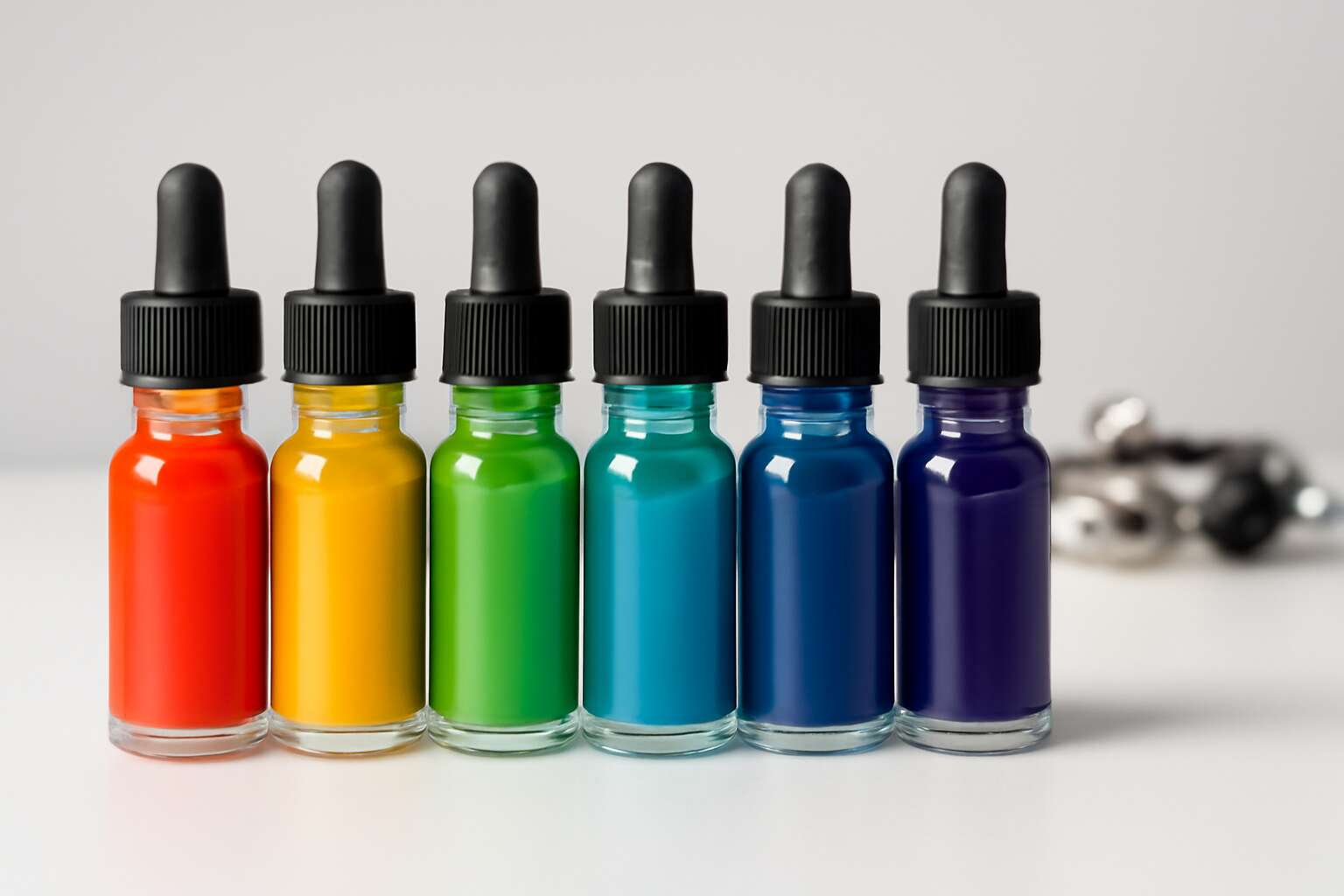
Understanding pigment-based tattoo inks
What are pigment-based tattoo inks?
Bright color still commands the eye. pigment tattoo ink shines, delivering a spectrum that black ink alone can’t match. Vibrant hues age gracefully, drawing clients in and keeping galleries of work looking fresh.
What are pigment-based tattoo inks? They suspend tiny pigment particles—minerals, synthetic hues, or plant-derived tones—in a carrier. Unlike carbon black, these inks offer a broader color library, with varying opacity and undertones. Formulation, particle size, and purity influence how a color sits under the skin and how it ages under sun and healing.
- Color range and vibrancy
- Lightfastness under UV exposure
- Safety, metal content, and regulatory alignment
Understanding these factors helps clinics and studios choose reliable pigment-based inks and set expectations for color longevity.
Common pigment color families and their roles
Color is a living echo in pigment tattoo ink, and some hues age with quiet grace while others reveal a sharper edge under the sun. From Cape Town studios to Joburg workshops, practitioners rely on reliable pigment families to keep work vibrant, legible, and true to the moment of insertion.
Common pigment color families and their roles in pigment tattoo ink guide the eye and set expectations across SA studios.
- Red and pink hues — warmth, skin-tone blending, and dramatic contrast
- Blues and greens — depth, shadow, and cool accenting
- Yellows, oranges, and peaches — brightness and highlights that lift designs
- Earth tones and blacks — neutral baselines, contouring, and long-term stability
These families inform how color longevity is discussed with clients, while reputable suppliers publish lightfastness data and metal content to support informed conversations about color aging under SA sunlight.
Difference between pigment-based inks and dye-based inks
Understanding pigment-based tattoo inks begins with recognizing pigment tattoo ink as color particles suspended in a carrier, not dissolved dyes. This distinction helps explain why pigment-based inks often stay truer and more legible over time, a trait sought by SA studios juggling sun, shade, and client expectations.
- Particle stability: solid pigments stay suspended in the carrier and resist diffusion.
- Lightfastness: pigment-based inks often outperform dyes under UV exposure.
- Color mixing: pigments offer a broader, more predictable range for matching skin tones and visibility.
In contrast, dye-based inks dissolve; color can migrate and fade with the ride-along sun and soap-wash. For practitioners, knowing which family a product belongs to helps set expectations about healing and long-term appearance in the South African sun.
How pigments are dispersed and stabilized in ink
Color longevity starts with physics. For pigment tattoo ink, color particles stay suspended in a carrier rather than dissolving, a distinction that keeps lines crisp and hues stable under the South African sun. The result is clarity that resists diffusion as routine heat and soap work their magic.
- Particle size and uniformity maintain even color and slow sedimentation.
- Dispersants and stabilizers prevent clumping and promote even suspension.
- Milling methods and processing control particle distribution.
- Carrier blend, pH, and viscosity influence flow and drying behavior.
Together, these factors explain why pigment-based inks often preserve legibility longer, a practical truth for studios navigating sun, shade, and client expectations.
Regulatory and safety considerations for pigment-based inks
Color is art’s handshake with policy, and in South Africa the safety framework keeps the drama from turning into regret. I’ve learned the quiet backbone it provides lets artists dream in vivid pigment.
Regulatory and safety considerations hinge on purity, labeling, and risk management. SAHPRA-style oversight and cosmetic-safety norms require pigment composition disclosures, allergen notices, and robust batch traceability. For pigment tattoo ink, reputable suppliers circulate certificates of analysis, minimizing surprise for studios and clients alike.
- Clear ingredient declarations and potential allergen notices
- Batch-level traceability and documented purity testing
- Independent verification and compliant packaging standards
Types of pigments used in tattoo inks
Organic pigments: definitions and examples
Bright, lasting color is the mark of good pigment tattoo ink. Organic pigments are carbon-based compounds derived from natural or synthetic sources, chosen for their vivid hues and strong lightfastness. They drive clean, stable tones clients expect on South African skin as it ages.
- Quinacridone red
- Quinacridone magenta
- Phthalocyanine green
- Dioxazine violet
These families offer a spectrum—from warm reds to deep greens—while remaining workable in dispersion and formulation. Understanding organic pigments helps studios select inks that deliver consistent coverage and longevity.
Inorganic pigments and mineral-based colorants
Mineral and inorganic pigments form the backbone of pigment tattoo ink, delivering bite and longevity even when the South African sun leans in. These colorants ride on minerals—stable, lightfast, and less prone to fading than organics—giving studios dependable coverage that ages with the skin.
Key inorganic pigment families include the following:
- Iron oxides (red, yellow, black) for earthy, reliable tones
- Titanium dioxide for clean whites and brightness
- Ultramarine blue and manganese blue for cool, stable blues
- Chromium oxide green for lasting greens
Ground to fine dispersion and stabilized with carriers, these mineral colorants lend predictable performance that can be traced through the life of a tattoo—season after season, fade-resistant and true to form.
Metal-containing pigments and nanoparticles
Color has a stubborn patience that outlasts fashion—one SA studio swears its orange never blinks. When we talk about pigment tattoo ink, two families stand out: metal-containing pigments and nanoparticles. These workhorse colorants leverage stable metal lattices or nanoscale physics to stay vibrant under heat and sun.
Here’s how they break down for practical use:
- Metal-containing pigments: crystalline oxides and salts that deliver durability and heat resistance
- Nanoparticles: sub-100 nm particles engineered for precise hue, brightness, and superior lightfastness
- Carrier systems: polymers and surfactants that keep metal pigments evenly dispersed in the ink
When properly stabilized, these pigment categories offer predictable performance that remains legible long into the future, even under harsh lighting and daily wear in the South African sun.
Chalks, carbon blacks, and blues: color stability implications
In the South African sun, color stability isn’t a luxury—it’s a practical requirement. For pigment tattoo ink, chalks, carbon blacks, and blues each respond to heat and light in distinct ways. Chalk pigments deliver punchy, sunny hues but fade faster under UV; carbon blacks offer superb lightfastness and crisp contrast; blues bring depth yet can drift toward teal or violet with prolonged exposure.
- Chalk pigments: vibrant but vulnerable to sun, fading and drifting pastel tones under bright light.
- Carbon blacks: superb lightfastness and crisp contrasts, with formulation affecting the depth of true black.
- Blues: rich and versatile, yet hue drift toward teal or violet can occur with sustained UV exposure and heat.
Choosing pigments with built-in stabilization defines longevity, readability, and true color over decades of wearing in the SA climate.
Color matching and pigment grading systems
Color science in tattoo inks isn’t guesswork—it’s a high-stakes negotiation with sun, heat, and the South African climate. In my studio, I call it pigment tattoo ink—the pragmatic choice that holds up under SA sun—three camps rule the spectrum: organic compounds, mineral-based colorants, and metallic particles, each bringing its own character to the mix. When choosing ink, you’re balancing vibrancy, stability, and safety as the sun ferociously tests every shade.
Color matching and pigment grading systems help you lock in consistency.
- Opacity, tinting strength, and true-to-chip color
- Lightfastness and UV stability across environments
- Dispersion quality and particle size for even application
This framework keeps pigment tattoos readable and durable over decades.
Safety, quality, and regulatory standards
Global regulatory landscape for tattoo inks
Across borders, the safety and quality of pigment tattoo ink are shaped by an evolving regulatory landscape. Regulators are increasingly scrutinizing impurities, colorfastness, and stability, pushing manufacturers toward transparent testing and robust quality control. The result is fewer surprises for studios and clients who demand consistency.
- Independent, third-party testing and certification of batches
- Clear ingredient disclosure and accurate labeling
- Traceability from raw pigments to finished ink, with auditable records
Global standards vary, but common threads include risk assessment, good manufacturing practices, and post-market vigilance. In South Africa, aligning with international expectations helps studios maintain compliance and protect clients, while ensuring pigment tattoo ink used is responsibly sourced and accurately represented.
Safety testing: what manufacturers test for
Safety testing is the quiet spine of pigment tattoo ink safety. Regulators are tightening their grip on impurities, colorfastness, and stability, nudging manufacturers toward transparent testing and robust quality control. For studios and clients, that means fewer surprises and more peace of mind about every drop of pigment tattoo ink.
- Heavy metals, residual solvents, and potential allergens
- Microbial contamination and endotoxin levels
- Colorfastness and light stability under UV exposure
- Batch-to-batch consistency and particle size
- pH, viscosity, and packaging integrity
Independent, third-party testing and certification keep the chain of custody honest. Clear ingredient disclosure and auditable records ensure traceability from raw pigments to finished ink, a necessity for South Africa’s studios navigating global expectations and responsible sourcing.
Ingredient transparency and labeling best practices
Safety isn’t a nice-to-have; it’s the quiet spine of pigment tattoo ink quality. As one veteran SA artist puts it, “If you can’t trace it, you can’t trust it.” Regulators are tightening, and transparency is becoming non-negotiable for studios and clients alike.
Ingredient transparency and labeling best practices hinge on clear disclosures, auditable records, and robust packaging controls. Each lot should bear complete pigment lists, supplier certificates, and batch numbers that travel with the ink from the warehouse to the studio. For pigment tattoo ink, transparency isn’t optional—it’s a safeguard that keeps artists honest and clients confident. Third-party testing and certification add a trusted stamp for colorfastness, stability, and impurity controls, reinforcing regulatory compliance within South Africa and beyond.
- Clear ingredient disclosure on the label
- Auditable batch records and traceability
- Independent certification and packaging integrity checks
Contaminants to watch for: heavy metals and impurities
In the quiet glow of the studio, safety isn’t a nicety; it’s the spine of every pigment tattoo ink that graces the workbench. I’ve watched studios tighten their sleeves and trace every bottle to its source—the kind of diligence that makes clients sleep better at night.
Contaminants to watch for include heavy metals and other impurities that can ride into a session unannounced.
- Heavy metals (lead, cadmium, mercury, chromium)
- Impurities (residual solvents, unbound pigments)
- Nanoparticles (uncontrolled particulates that affect stability)
Auditable batch records and traceable packaging are the quiet guardians of quality. For pigment tattoo ink, third-party testing and independent certification bolster confidence in colorfastness, stability, and impurity controls, ensuring compliance with South Africa’s evolving rules and the expectations of discerning clients.
Batch consistency, shelf life, and storage
In the quiet hum of the studio, safety, quality, and regulatory standards hold steady as the spine of every pigment buy and mix. Batch consistency is not a buzzword but a discipline—color, viscosity, and particle load must track from run to run. A clear shelf life policy protects both the artist and client’s confidence, while careful storage decisions—cooler temperatures, away from bright light—keep pigment tattoo ink stable from first use to the last drop.
To maintain predictable performance, implement these storage and handling guidelines:
- Store in a cool, dry place out of direct sunlight
- Keep containers tightly sealed and upright to prevent moisture ingress
- Rotate stock using FIFO to minimize expiration risks
- Label with batch and expiry information so regulators can trace provenance
Practical guidance for artists and studios
Choosing pigments for different skin tones and types
Color is the final signature in tattoo work, and in South Africa’s buzzing studios, it can either sing or sag! “Color is life,” a client once told me, and that truth rings through every shade we mix. When we talk pigment tattoo ink, the choice is as much craft as chemistry, shaping how a piece feels long after the needle rests.
Here are practical guiding steps for choosing pigments for different skin tones and types:
- Assess undertones (cool, warm, olive) and adjust with a balanced base.
- Start light and build: layer gradually to preserve clarity on darker skins.
- Verify dispersion and stability across pigment families before committing.
In my studio, I keep a small library of swatches for quick reference and share samples with clients to align expectations and outcomes.
Color theory and mixing pigments safely
“Color is life,” a client whispered, and in South Africa’s buzzing studios the pigment tattoo ink can sing or sag long after the needle rests. I watch the color settle like a heartbeat, and color theory isn’t whimsy—it’s guides how depth travels over diverse skin tones and the way a piece breathes at healing time.
Practical guidance for artists and studios centers on a personal color map and a disciplined mixing rhythm, done safely.
- Maintaining a balanced base that respects undertones across a swatch set.
- Prioritizing dispersion stability across pigment families as a guiding principle.
- Keeping records of ratios, batch numbers, and client expectations for repeatability.
With these habits, pigment tattoo ink becomes a measured craft—clear, predictable, and a touch of the uncanny in every final line.
Application tips to maximize pigment longevity and vibrancy
Across South Africa’s studios, 9 in 10 artists say longevity hinges on disciplined dispersion and mindful technique. The goal isn’t flash—it’s how pigment tattoo ink settles, breathes, and endures through healing. A steady hand and a patient approach keep color honest in every complexion.
- Calibrate color on a controlled swatch with a calm, measured mix to preserve edge and vibrancy across tones.
- Keep dispersion stable by rotating pigments and using gentle, even stirring; avoid heavy shaking that introduces bubbles.
- Record practical outcomes with concise notes on color response to guide future sessions.
When the session ends, clean lines and lasting brightness come from both science and care—proper post-care guidance, attention to light exposure, and thoughtful layering. This is how the craft earns its place on skin that tells a story long after the needle rests.
Post-procedure care and pigment retention
Across South Africa, studios reveal a striking truth: eight in ten artists say pigment retention hinges on patience, discipline, and the way color settles rather than flashes of shade. For pigment tattoo ink, the healing dialogue is a conversation between skin and pigment, a story of breath and balance that endures long after the session ends.
Post-procedure care blends science with ceremony—careful light exposure, moisture management, and the subtle layering that preserves edge integrity across skin tones. When studios observe how color responds to healing and log practical notes, future sessions rise in clarity and confidence.
- Observe pigment response across different skin tones
- Document outcomes to guide future sessions
- Maintain a clean, consistent studio environment to support retention
Common ink-related issues and troubleshooting
A quiet truth hides in the healing hours: pigment tattoo ink seals its fate in patience as much as pigment. After the session, the skin and the color trade whispers, and I hear where tone settles and where it waits. Edges soften into the long story of recovery.
Practical guidance for studios blends craft and science. For pigment tattoo ink longevity, assess dispersion and carrier viscosity before loading the needle; calibrate depth and cadence to your machine; reinforce gentle aftercare during the first week to protect edge integrity.
- Verify pigment dispersion and settling to predict color drift.
- Fine-tune needle technique to maintain consistent line and fill.
- Log healing responses to guide future pigment choices.




0 Comments