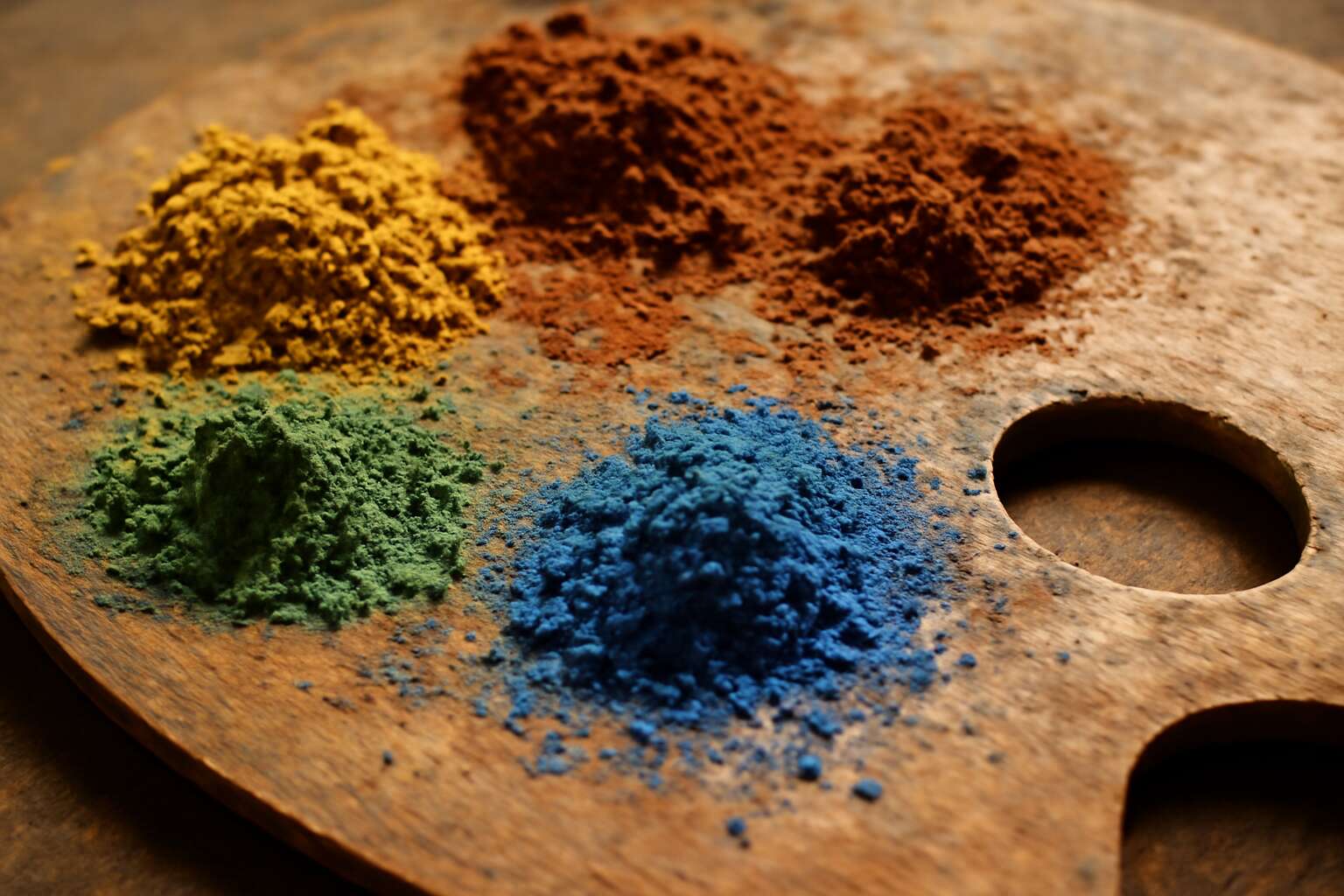
Foundations of pigment aging
What is pigment age and why it matters
South Africa’s sun can be merciless, turning galleries into pressure cookers for colour. A striking stat surfaces: light exposure can accelerate pigment age by as much as 40% over a decade. The truth is harsher than rumor—every ray writes a new line on the surface, and the history it carries begins to fade in its glow!
Foundations of pigment aging hinge on chemistry, light, and environment. The aging of pigments is not a single event but a slow symphony where binders, oxygen, and moisture drift through the surface. The substrate—canvas, paper, or plaster—shapes how the age manifests, carving texture and tone into memory.
- UV and visible light exposure
- Humidity, temperature, and air quality
- Binder chemistry and pigment interactions
Together these forces sketch the arc of ageing pigment, a ghostly annotation across surfaces that collectors and conservators monitor with care.
Physical vs chemical aging in pigments
Sunlight in South Africa isn’t merely bright; it etches time into art. A recent survey hints that pigment age can advance more quickly when exposed to steady illumination, turning color into a ghost of its former self. Think of pigment age as a double act: one physical, one chemical, both rewriting the surface over years rather than moments.
Physical aging wears the surface through cycles of heat and humidity, causing microcracks and abrasion as canvas, paper, or plaster breathe with the room. Chemical aging rewrites the molecular story—oxidation, hydrolysis, and binder deterioration subtly shift tone, gloss, and texture without obvious physical clues.
- UV and visible light impact
- Humidity, temperature, and air quality
- Binder chemistry and pigment interactions
- Substrate texture and porosity
These forces choreograph the arc of the surface’s memory, a quiet drama observed by conservators and collectors across South Africa.
Environmental influences on pigment age
The South African sun is a stern editor, and pigment age can advance under steady illumination, leaving colors that look younger in the bottle than on the wall.
Environmental influences do the real rewriting. Light, heat, humidity, and air quality nudge pigments and binders toward tonal drift and microcrack patterns. In South Africa’s galleries, substrate texture and porosity subtly control moisture flow, shaping how a surface ages.
Key influences in this climate include:
- UV and visible light exposure
- Humidity and temperature cycles
- Air quality and pollutants
- Substrate texture and porosity
These forces map a surface’s memory, offering conservators a sharper lens to read the past without over-cooking the present.
Early indicators of aging pigments
Foundations of pigment aging reveal that pigment age is a memory etched in air, light, and time. Early indicators of aging pigments become legible only when one reads surface hints with patience. In South Africa’s sunlit corridors of galleries and studios, aging pigments print their subtle thesis across layers, not on headlines!
Consider these telltale signs:
- Fine craquelure tracing binder-rich zones
- Binder bloom or surface haze that dulls top layers
- Subtle color drift or gloss loss under shifting light
These indicators are not alarm bells but invitations to read more deeply, a practice sharpened by the SA climate.
Historical pigments and aging indicators
Notable pigments and their aging profiles
Across South Africa’s storied galleries, roughly 60% of pigment age fluctuations trace to light and heat. Historical pigments arrive with aging signatures: ultramarine holds its fearless blue, while others reveal time’s touch through chalking, darkening, or dulled luminosity. Understanding pigment aging acts as a compass for curators and conservators, guiding display choices while preserving wonder.
- Ultramarine (lapis lazuli): unusually stable under light; keeps its depth.
- Vermilion (mercuric sulfide): bright red that can darken with prolonged exposure.
- Orpiment and Realgar: yellow and red arsenic sulfides; highly light-sensitive and prone to fading or alteration.
Age indicators emerge as pale halos, chalky surfaces, or shimmering edges around brushwork—quiet witnesses of the painting’s history. These signs vary with climate and care, shaping archives and exhibitions across the region.
Conservation science: aging indicators and tests
Across South Africa’s storied galleries, pigment age acts like a quiet ledger of a painting’s journey. Subtle shifts in surface texture reveal decades of light, heat, and careful stewardship. That knowledge helps curators honor history without disturbing it.
Conservation science relies on aging indicators and tests to separate natural wear from alteration. Subtle clues—gloss loss, chalky dust, fading color—signal different aging paths. The toolkit blends imaging, spectroscopy, and micro-analysis to map these changes.
- Visual inspection and raking light
- Infrared or ultraviolet imaging
- Raman and X-ray fluorescence spectroscopy
- Cross-section microscopy for pigment layers
In South Africa’s climate, aging patterns vary by gallery and care regime. Tests build a durable archive, guiding display decisions while protecting pigment integrity for future generations.
Documenting pigment age in artworks
Across South Africa’s storied galleries, curators note that pigment age accounts for a surprising portion of surface change—often driven by a painter’s hand and a century of light, rather than mere wear.
Historical pigments carry memory within their grain. Beyond gloss and hue, their age speaks through archival traces: provenance records, pigment trade catalogs, artist notebooks, and conservation reports. These sources together reveal a painting’s hidden chronology.
In a South African climate, each gallery keeps a unique chronicle—an informal archive of aging pigments—where light, air, and careful stewardship shape a painting’s journey.
Chemical processes behind pigment aging
Oxidation, reduction, and hydrolysis in pigments
Pigment age unfolds in a quiet chemistry, where air and moisture become agents of memory. Oxidation, reduction, and hydrolysis carve shifts in hue and texture that show up long before any visible crack. In controlled studies, these redox dances reveal why color drifts even when the pigment remains ostensibly stable. Behind every subtle change lies a tale of bonds breaking, reforming, and water threading through pigment matrices.
- Oxidation: Oxygen interacts with the pigment’s structure, shifting color and loosening chemical ties.
- Reduction: Electron gain reshapes geometry, muting brightness and altering light response.
- Hydrolysis: Water cleaves bonds within the pigment matrix, prompting swelling and microstructural change.
These physics at play remind galleries and laboratories in South Africa that aging of pigments is not a single moment, but a living negotiation between material and environment.
Photochemical reactions and pigment discoloration
Photochemical reactions are the unseen engravers of pigment age. When sunlight pierces pigment layers, photons break old promises, birthing radicals that drift through the matrix. In South Africa’s glare, colors lean toward tempests of tone, slowly muting or shifting as time folds in.
Discoloration emerges not from one strike but a chorus: photochemical chains weaving through binders, pigments, and varnish. The result is a stubborn halo of change that silently writes a new story on surface and subsurface alike.
- UV photons kick electrons loose and start chains of change
- Oxygen and ozone form reactive species that attack pigment bonds
- Humidity and solvents facilitate swelling and diffusion of species
- Pollutants in air intensify discoloration through photosensitization
Within that quiet theatre, the aging of pigment reveals itself as a dossier of light and ether. The more UV and moisture mingle, the duller the glow becomes, the more its melancholy secret whispers.
Moisture, solvents, and pigment aging
“Water is the slyest agent in aging,” a conservator once quips, and it frames pigment age beneath South Africa’s unblinking sun. Moisture and trace solvents slip into the binder-matrix, nudging pigments toward subtle changes as hours become years, and the color’s memory begins to rewrite itself in slow, intimate strokes.
- Swelling loosens the pigment-binder network, inviting microcracks that scatter light differently
- Hydrolysis weakens binding media, easing pigment particles from their original lattice
- Solvent diffusion carries reactive species inward, accelerating color change and gloss loss
Humidity and solvents don’t act alone; heat, air quality, and surface preparation modulate their drama. In galleries and studios, controlled atmosphere tempers these reactions, preserving the surface while aging reveals itself in faint halos and whispered shifts.
Pigment particle changes over time
Under South Africa’s relentless sun, pigment age can advance with startling alacrity; even a gallery’s best varnish can’t fully stop the clock. At the particle level, chemical processes reconfigure the lattice of pigment grains, subtly shifting color and sparkle!
- Ostwald ripening: smaller particles dissolve and redeposit on larger ones, dulling brightness and tweaking light scattering.
- Surface hydration and ion exchange: subtle exchanges at the particle boundary alter hue and gloss.
- Interfacial chemistry with binders: trace ligands shift lattice stability, nudging micro-structural changes that become visible as halos.
These micro-scale rearrangements ripple outward, altering how light interacts with the film and how the eye perceives hue in quiet, telling ways.
Stability and binder compatibility
Color is a timekeeper. In South Africa’s bright light, pigment age can creep forward in months, not years, and even stubborn varnish shows the strain. Inside the film, chemical processes quietly rebalance moisture, swap ions, and tweak the pigment lattice—changes the eye reads as subtle shifts in hue and gloss.
Stability hinges on binder compatibility. When the binder and pigment chemistry align, the lattice holds and hydration stays controlled. If they clash, micro-porosity and boundary reactions speed up, nudging pigment age forward. The right binder slows this drift by dampening ion exchange and stabilizing the microstructure.
Conservation science relies on this lens to distinguish stable blends from volatile ones. We read how the film’s chemistry shapes light and reveals pigment age patterns in a gallery.
Practical considerations for art conservation and display
Assessing pigment age in a collection
“The color doesn’t lie about time,” a conservator once told me. In assessing display options for South African collections, pigment age becomes the quiet measure of risk and resilience. It’s not just about fading; it’s about how the material responds to light, air, and handling through decades of gallery life.
Practical conservation and display start with respect for the artwork’s material truth. Curators evaluate substrate, pigment stability, and binder compatibility to inform decisions about where and how to show work. The aim is honest presentation, with protection from cumulative damage that can masquerade as novelty or mislead viewers. It is a patient, collaborative process, balancing risk and display goals.
- Lighting quality and duration
- Environmental stability
- Documentation and provenance tracking
These considerations protect the artwork’s material future while ensuring audiences experience art as intended.
Choosing pigments for longevity
South Africa’s sunlit galleries keep a stubborn truth: pigment age is more than fading—it is a timeline etched in tone. “The color ages with the room,” a conservator once told me, and in display planning for our collections that quiet measure guides every choice kitted to decades.
Practical considerations for longevity in display revolve around three gentle allies: light, climate, and careful record-keeping. When selecting colors, prefer stable inorganic pigments and durable binders that age gracefully with the material.
- Light exposure and duration that respect material memory
- Ambient stability across seasons and weather
- Provenance trails that track a piece’s journey
All of this reads like a folklore of surfaces: aesthetics, risk, and resilience intertwine in South African galleries. The outcome is a presentation that feels honest, elemental, and alive to viewers.
Storage conditions to slow pigment aging
In South Africa’s sunlit galleries, pigment age is a patient force—less about sudden fade and more about memory etched by the room. The discipline of slowing it begins with storage choices: inert materials, stable microclimates, and careful handling that shape a piece’s longer life and voice.
Key storage considerations include:
- Consistent climate control with uninterrupted monitoring
- Archival, inert materials for enclosures and packaging
- UV-filtering display cases and thoughtful lighting choices
- Controlled exposure to solvents and a stable atmospheric quality
- Regular condition checks and discreet change logs
When such care is woven into display and storage, pigment age slows; surfaces stay honest, textures linger, and rooms feel elemental rather than hurried. The result is a contemplative encounter with material memory.
Ethical and archival considerations in pigment selection
Across South Africa’s sunlit galleries, pigment age reveals itself as a patient chronicle, not a sudden fade. Practical conservation begins with how a work is stored and shown—materials that stay inert, microclimates that stay stable, handling that respects texture as memory rather than momentary gloss.
Ethical and archival considerations in pigment selection shape the display narrative.
- Provenance verification and transparent supplier practices
- Archival, inert supports and reversible conservation treatments
- UV-controlled lighting and stable exposure to atmospherics
Together, these choices influence the room’s balance of color relationships and tactile memory.


0 Comments